Please press (at least!) one of these.
It costs you nothing, and (possibly) helps us spread the word!
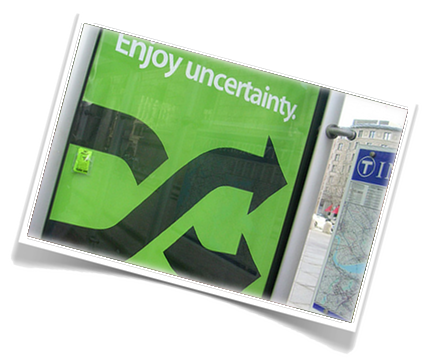
Doubt versus uncertainty
Monday, 15 February 2010
After a little, positive, distraction last week, with articles looking at how to lead and whether molehills can actually be mountains from time to time (see here later), we’re back on track with the series of articles that started at the end of January. This series of articles outlined, and is now covering, the continuum from absolute, irrevocable certainty through to eternal and enduring doubt, with a bit of positive mental attitude in the middle.
Today’s article is going to look at stage three along the continuum, which I’ll redefine here as:
- absolute certainty
- positive thinking
- moments of doubt
- I just don’t know
The title of this part of the series makes a specific distinction between doubt and uncertainty, and, for the purposes of this article, I’m going to make one of the definitions a positive one, and the other a negative one.
Uncertainty
My very, very favourite quote of all time, from Socrates:
The more I learn, the more I learn how little I know
There is the potential, for me, to become slightly disheartened by such a statement from someone I consider to be such a great thinker. Especially when he doesn’t stop there – a small selection from his thoughts on this topic:
- I know nothing except the fact of my ignorance
- I know that I am intelligent, because I know that I know nothing
- The only true wisdom is in knowing you know nothing
- To know, is to know that you know nothing. That is the meaning of true knowledge
- True knowledge exists in knowing that you know nothing
- True wisdom comes to each of us when we realize how little we understand about life, ourselves, and the world around us
- As for me, all I know is that I know nothing
As I said, this could be disheartening, but I choose to be heartened by it. Learning and development is a limitless area to work in; it is never finished; we can never put our feet up knowing that it is done; but we can continue to develop, to get better and better, to know more and more, and to evolve our knowledge and understanding of the world.
Obviously, as someone who works in coaching, training and development, this is all rather fortunate, as there is a limitless supply of work (!), but there are advantages for everyone in this model. The primary one is the comfort that can be derived from the knowledge that you do not need to have, and indeed can never have, absolute certainty. It’s a chimera, and it’s more than OK not to know – you’ll be in great company with Socrates.
Doubt
Doubt, for me, is the less useful twin of uncertainty. Both states are about not knowing, but one is a much more comfortable, confident place to be than the other; uncertainly can be held with conviction, but doubt can’t.
Doubt, I believe, is driven by a lack of confidence, contrasted with a certain knowledge of uncertainty. Someone who doubts can be easily swayed, persuaded and cajoled into doing things, because the superficial confidence and certainty of others can be extremely appealing. Those others can be a rock to cling onto in a storm, but the danger is that they are a rock that (a) has no foundation; and (b) doesn’t know that they have no foundation.
Being more comfortable going with the flow, accepting uncertainty as a fact, and ceasing to contrast yourself with the more certain others out there is a tough, but liberating experience.
--
This biggest challenge for me is not in making the distinction between these two areas; it’s more about being comfortable with being uncertain, and confident about not being 100% confident about everything, all the time. I tend to, in my head, question those who express absolute certainty:
who are they really trying to convince?
Please press (at least!) one of these.
It costs you nothing, and (possibly) helps us spread the word!