trainingreality helping people work better with people
nlp misuse
Please press (at least!) one of these.
It costs you nothing, and (possibly) helps us spread the word!
NLP and a step too far

Friday, 21 August 2009

One of the most powerful aspects, for me, of NLP is the underlying principle that we, as individuals, are responsible for our reactions to the behaviour of others. This is a fabulous starting point, as it combines giving us the right and acknowledges the ability to control our own responses with the knowledge and understanding that others cannot control us. Wonderful - we’re in charge of ourselves!

If only it were truly as easy as that! Some trainers (I hasten to add, not the people who trained me, who were wonderful) use this, and other NLP techniques and tools, as simple quick fixes, but I genuinely don’t think life is like that. At times, it can be much harder, much more complex, and that’s where reverting to the basic principles, rather than the specific tools, is really helpful.

As an example, one of the phrases I hear “misused” too often (once would be too often in my book!) is “I’m sorry you’ve taken it that way”, or variations on the theme. I think it is possible to use this type of phrase in a respectful and useful way, but I hear it more often in a way that is more closely linked to either gaining power over someone else, or abdicating responsibility for your actions.

The underlying problem is one of balance. If I wander around saying and doing whatever I like to anyone else, with the smug and self-satisfied smile of someone who will simply turn around and say “it’s your choice”, “you’re letting me hurt you”, “you’re choosing to take it that way”, I might be right at some level, but I’m not showing any respect, any responsibility, or indeed any decency.

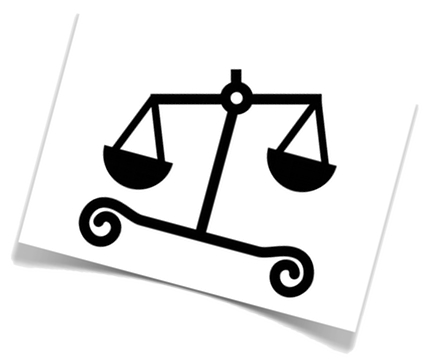
In these circumstances, the balance is out-of-kilter. The two weights on the scales in the “evil-NLP’er” mode are:

1) You are responsible for your reaction to me.

2) I don’t take responsibility for your reaction to me.

In this case, the weights are effectively on the same side, but they are on the side of the other person. Despite the fact that you showing no responsibility, you are expecting the other person to take all the responsibility.

You don’t need to change many words to translate this to a much more principled, appropriate, and decent balance of weight on the set of scales:

1) I do take responsibility for your reaction to me.

2) You are not responsible for my reaction to you.

In this case, the weights are again on one side only, but they are on your side, not the other persons. After all they are your weights in the first place - you can’t simply foist them on others.

The significant difference between these two is that the first set, whilst being in line with NLP is some respects, completely misses the point that we all need to start by taking ownership for ourselves - it’s about us and what’s inside, not about imposing that on other people. The second set shows complete ownership, and therefore is much more in line with a prinicple-led approach to NLP.

I’d love to get further examples of how fundamentally good models and training material can be so easily warped, misunderstood, and misused - shine a bright light into the darker recesses!


Please press (at least!) one of these.
It costs you nothing, and (possibly) helps us spread the word!
Please leave your thoughts and comments here

There are 8 comments
gravatar Sean Owen-Moylan – Cardiff
August 24, 2010 - 10:30
Subject: Trying to balance the scales

Hopefully practitioners remember the presupposition "The meaning of your communication is the response you get" and recognise the connection between their messages and the reactions. I also use Erickson's maxim that his clients knew more about their situation than he ever would. I find that is enough to prevent me getting smug

Reply to Sean Owen-Moylan
gravatar Simon Roskrow – North Yorkshire
September 02, 2010 - 16:39
Subject: Re: Trying to balance the scales

Hi Sean - thanks for your comment.

I'm wildly in agreement with you - the critical aspect is taking responsibility yourself rather than imposing responsibility on others. In very general terms, decent practitioners who've taken learning NLP seriously will/should understand that balance; others, who've perhaps scratched the surface of training (perhaps looking for tools, tips and tricks) tend not to understand that subtlety.

I love the concept of ensuring that you don't get 'smug' - that should be a golden rule for every trainer, coach, teacher...person!

Thanks again, Simon.

gravatar John
September 03, 2009 - 09:37
Subject:

Hello. I came across your blog through google alerts for ‘NLP.’ I have this alert set so I can link up with people in the NLP niche for a joint venture affiliate marketing opportunity. I have a whole proposal worked up and I would like to send it to you but only upon your approval. If you are interested to see what the joint venture would be for check out my website www.networkingnotecards.com. If this is something you might be interested in promoting for an affiliate commission let me know. Thanks!

John
Founder How2Talk2.com

gravatar Lesley – ?
August 27, 2009 - 10:36
Subject: Trying to balance the scales

Simon regarding this subject and NLP I think the teachings of Reg Connolly founder of Pegasus NLP show us the way. If we ensure that all our communications utilise the 4 R's - Respect, Recognition, Reassurance and Responsibility then we will have met all the criteria you mention. If someone still 'chooses' to be upset, offended etc. then we will know that they have chosen that reaction in order to meet their own agenda. As Reg would say "every behaviour has a positive intention even if it is not immediately apparent".

For instance, if we are communicating with someone who is stuck in 'victim thinking' they may decide to react negatively to whatever we say and however we say it and we cannot be responsible for that.

gravatar Reeta Luthra – Aylesbury
August 22, 2009 - 19:22
Subject:

Simon, I totally agree. You're describing the flippancy with which some NLPers discard the responsibility of *their own* side of the conversation and lose sight of the basic principles.

It reminds me of someone I know who went on a course and returned with a new "It's your choice to feel this way" attitude indiscriminately applied to all situations. She even ended a long-term relationship by email, telling her partner "It's not my fault if you've chosen to be upset" and "I don't mind if you want to blame me if it makes you feel better"

Technically, they were true statements... but practically they're a bit devoid of respect and sensitivity.

I think the depth of our understanding of NLP principles proves itself, not in training rooms or in therapy consultations, but in our everyday interactions with real people in real situations.

Reply to Reeta Luthra
gravatar Simon Roskrow – Yorkshire
August 26, 2009 - 16:57
Subject: Spot on

Hi Reeta. You've hit the nail squarely on the head with your reference to being "devoid of respect and sensitivity". If I were a great tennis player (I'm not, before anyone adds a comment to that effect!), then playing a friendly against a much weaker player but using the fanciest "techniques" I could muster would be pretty pointless, and potentially damaging. Using NLP is this way is essentially bullying - the big kid in the playground picking on a younger one "because he can".

I also really like your distinction between training rooms/therapy and everyday life. If we can't live our lives (mostly) appropriately, how can we expect to coach others?

gravatar Alice – Cambridge
August 21, 2009 - 22:11
Subject: Trying to balance the scales

Yes, I absolutely agree that we must take responsibility for our actions and the reactions they create. However, there is danger in taking too much responsibility and becoming a victim, so that anyone's reaction becomes "your fault". I like the NLP principle of choosing a response and trying another one when a first method doesn't work. Then trying again, and again.....
So, I take responsibility for what I say and I try to take note of the reaction so I can use it as feedback. But I do not feel bad about their reactions, and do not take my responsibility that far!

Reply to Alice
gravatar Simon Roskrow – Yorkshire
August 26, 2009 - 17:06
Subject: Re: Trying to balance the scales

Hi Alice. It's yet another fine balancing act - taking "appropriate" responsibility without putting oneself in the victim position. Not "feeling bad" seems to be a sensible approach, as it can lead to feelings of guilt, but there maybe times when each of us does need a bit of a kick.

One thing that helps me, when I remember (!), is to work to see the situation from the other's perspective. If that is done genuinely and honestly, it can help you to evaluate whether there is any need to give yourself a bit of a kick...I know I need on from time to time!

Leave a Comment


?
? ?
?

Powered by TalkBack